The future of education relies on multidimensional bases for social and individual needs. It is important to create an entire picture based on inclusiveness and solidarity in order to foster community knowledge. The image below shows our view of this full picture.
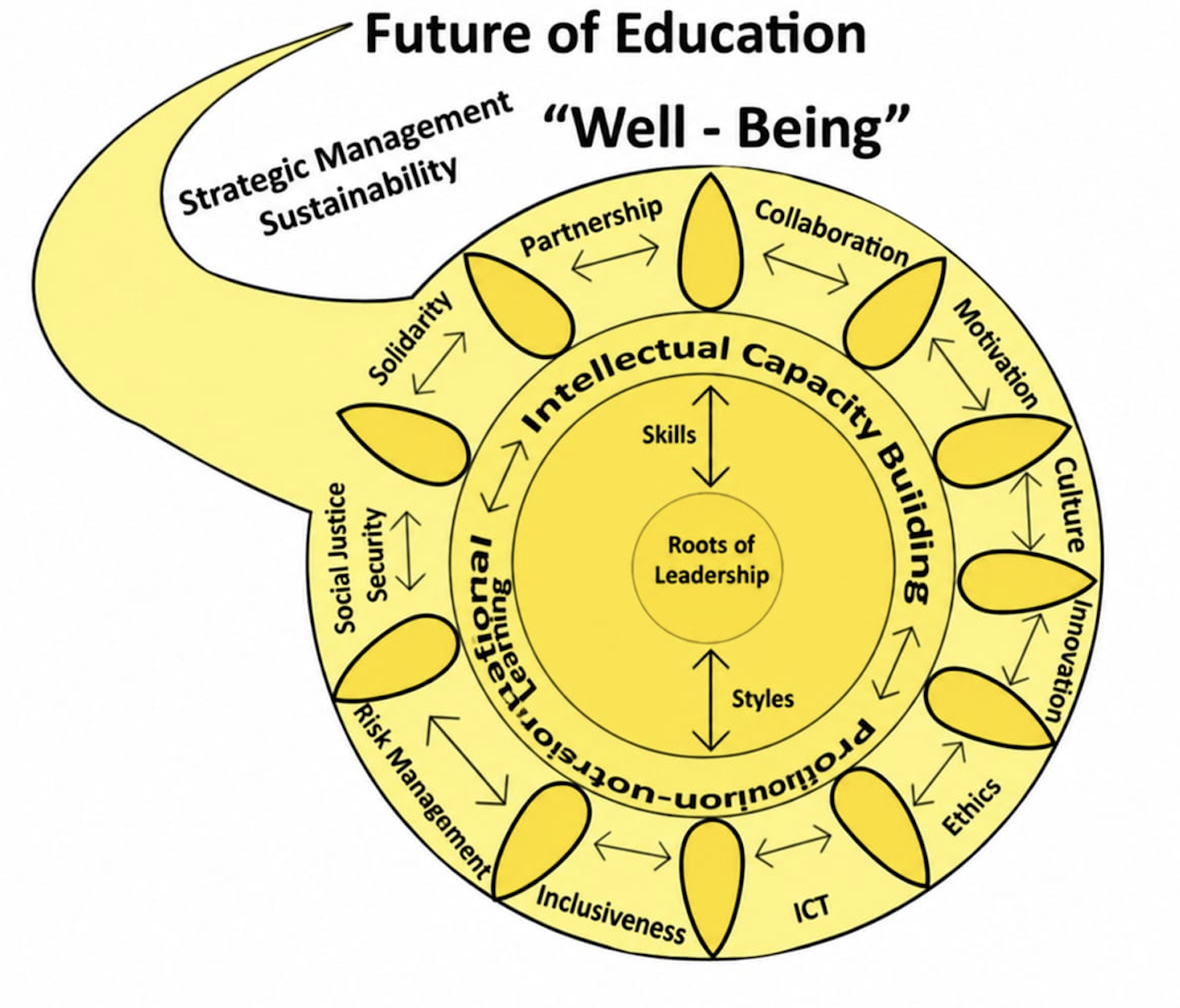
Considering the future of education through metaphoric interpretation helps us reflect. In this respect, larva and sunflower are two metaphors that are used in the model shown in the above image, as a way to examine the functions of technology in education and society.
We view larva as a metaphor to look at the future of education since the pandemic times, since education has changed so substantially through the impact of technology. Sunflower is used as a metaphor to indicate that there are great hopes for education to become better than it has been in the past. As seen in the above model, well-being is the core stance of our view of the future of education, including digital well-being. There is an intensified need for strategic management for sustainability. Collaboration, partnership, solidarity, social justice, risk management, inclusiveness, information, communication technologies, ethics, innovation, culture, and motivation are basic leaves of the sunflower to be opened for profession, transformational learning and intellectual capacity building. These leaves’ roots belongs to leadership. In the digital transformation, leadership skills and styles are important to create a full picture for the future of education.
The future of education is connected to emerging technologies, which can enable making services available to all. Accessibility, inclusiveness and universal values are crucial to enrich the quality of education for all. Collective actions focusing on sustainable development goals and the opening of all educational services—like a larva for the future of education—become essential for global digital citizenship. Connected societies can establish a shared vision for the global citizenship. Therefore, it is critical to teach social values, and technology can help enable that.
We, the authors, are two minds for one vision in order to work on social impact projects that can remove barriers in people’s hearts that prevent them from starting transformations. At our university, the Societal Research and Development Center was established in 2013; at this center, we place an emphasis on prioritizing issues such as disability, women, elderly people, well-being, youth and children. The center looks to achieve quality education (as per the UN’s Sustainable Development Goal 4, or SDG 4); gender equality (SDG 5); reduced inequalities (SDG 10); peace, justice and strong institutions (SDG 16); and partnership for the goals (SDG 17).
We aim at equality, inclusiveness and accessibility through human-centered values while designing our projects following a “starfish” model. Renewing efforts and actions based on the merits of emerging technologies fosters social entrepreneurship. Technology becomes bridges while implementing our model within the academic and social impacts of our work. In addition, we have been awarded social responsibility roles; more information is available at https://bulletin.neu.edu.tr/2025/12/18/two-minds-one-vision-the-academic-and-social-impact-of-zehra-and-fahriye-altinay/.